About Rice Crop Manager
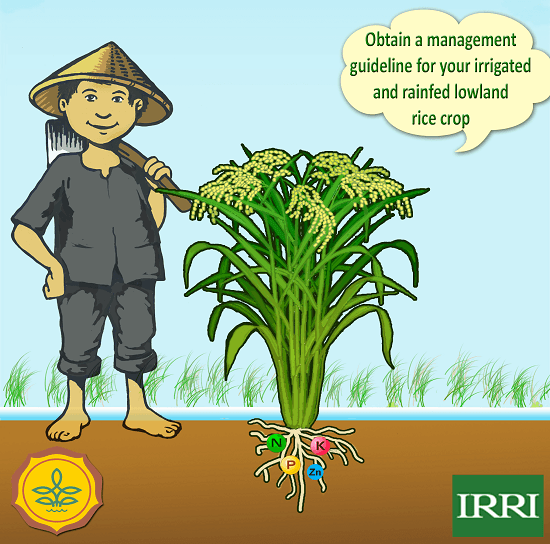
Rice Crop Manager provides irrigated and rainfed lowland rice farmers in Indonesia with a crop and nutrient management guideline customized to the needs of an individual farmer. Rice Crop Manager uses a farmer's answers to questions on their rice farming practices to automatically generate a rice management guideline aimed at increasing the farmer's net income by an equivalent of US$ 100 per hectare per rice crop
Rice Crop Manager is designed for use by extension workers, crop advisors, input providers, and providers of services who interview a farmer using a computer or smartphone. After the interview, the collected information is stored on the computer or smartphone until the Web browser is connected to the Internet. Collected information is then transmitted via the Internet to the Rice Crop Manager 'model', which calculates and transmits a crop management guideline back to the computer or smartphone. Each guideline provides an actionable recommendation, which matches the location-specific cropping practices and needs of a farmer. The guideline is provided to the farmer as a one-page printout and in some cases by SMS to the phone of the farmer.
Rice Crop Manager was developed from Nutrient Manager for Rice. The following organizations contributed to the formulation and field evaluation of Nutrient Manager for Rice, which is the precursor to Rice Crop Manager and provides the nutrient management component in Rice Crop Manager.
The nutrient management guideline provided by Rice Crop Manager is based on the principles of site-specific nutrient management (SSNM) as described in the following publication:
Fairhurst T, Witt C, Buresh R, Dobermann A (editors). 2007. Rice: a practical guide to nutrient management. Second edition. Los Baños (Philippines): International Rice Research Institute and Singapore: International Plant Nutrition Institute and International Potash Institute.
Click here to view the publication.
The development of Rice Crop Manager was made possible through support from the
For additional information, please contact:
Zulkifli Zaini
Country Representative for Indonesia
Jl. Medeka 147, Bogor 16111, Indonesia
Tel: +62 25 1833 4391
Fax: +62 25 1833 4354
E-mail:
z.zaini@irri.org
Roland J. Buresh
International Rice Research Institute
DAPO Box 7777
Metro Manila, Philippines
E-mail:
r.buresh@irri.org
Developed by the:
International Rice Research Institute

as a product of research collaboration with:

© International Rice Research Institute 2014
Terms and conditions
Rice Crop Manager provides a crop and nutrient management guideline for rice in irrigated and rainfed lowland environments of Indonesia. The use of this software is subject to the following terms and conditions:
The International Rice Research Institute (IRRI) does not endorse or promote specific agricultural inputs and fertilizers, and it does not guarantee the accuracy of an analysis labeled on commercial agricultural input and fertilizers. The software assumes that the N, P2O5, and K2O analysis labeled on a bag of fertilizer or organic material accurately reflects the content of plant nutrients. Many factors beyond the scope of Rice Crop Manager—such as climate and water availability—affect rice yield. IRRI does not guarantee a targeted rice yield will be attained with the provided crop management guidelines. The content of the software is subject to change without notice.
Limitation of liability
Under no circumstances and under no legal theory, whether tort, contract, or otherwise, shall the Board of Directors of the International Rice Research Institute (IRRI) or any of its affiliates, officers, employees, or other representatives be liable to you or any other person for any direct, indirect, special, incidental, or consequential damages of any character including, without limitation, damages for loss of goodwill, work stoppage, computer failure or malfunction, or any and all other commercial damages or losses, specifically including damages to crops and soil resulting from the application of the software, or for any damages or liabilities even if IRRI shall have been informed of the possibility of such damages or liabilities, or for any claim by any other party. This limitation of liability shall apply to liability for death or personal injury except to the extent applicable law prohibits such limitation.
Diluncurkan oleh Menteri Pertanian pada 20 Januari 2011
© International Rice Research Institute 2014
Reference number: ######
Farmer name:
Name of farmer leader:
Cellphone:
Field name
Location:
Date generated: xx, xxxx
Field size:
Rice crops per year
Seedling age:
Water regime:
irrigated/rainfed
Crop establishment:
Transplanted
Variety:
Variety 2:
Variety:
Seedling age:
Seedling age:
Season:
Sowing date:
Note: Use this recommendation for (selected) season yearonly.
(fresh weight)
var1 var2
Reported current yield on # unit:
Variety 1: kg (fresh weight)
Variety 2: kg (fresh weight)
Attainable yield on # unit:
Variety 1: kg, t/ha (14% MC)
Variety 2: kg, t/ha (14% MC)
fresh weight
Reported current yield # unit:
xxxx kg, ya t/ha (14% MC)
Variety 1: xxxx kg, yaa t/ha (14% MC)
<
Variety 2: xxxx kg, yab t/ha (14% MC)
:
 Use new certified seed each wet season.
 Use certified seeds.
 Use Inpari 13 for resistance to BPH.
 Use submergent tolerant varieties like Inpara 3, Inpara 4, Inpara 5 or Inpari 30.
Use higher plant population through 20cm x 20cm square planting or legowo.
Reduce risk in rat damage through legowo.
 Do not apply insecticide within 30 DAT (or 40 DAS/DAE). Plants compensate for early dmage caused by defoliators; no spray also conserves beneficial organisms.
 Plow and flood rice field as soon as possible. Cover nursery with a net to keep out insects.
 Plow and flood rice field as soon as possible.
 Apply:
| Growth Stage |
DATS* |
Fertilizer amount for |
|
Delay urea application when field is overflowing with water or dry at |
| Variety 1 |
Variety 2
|
| DATS* |
|
Urea (46-0-0) |
SP36 (0-36-0) |
* |
Urea (46-0-0) |
urea |
* |
|
Urea (46-0-0) |
SP36 (0-36-0) |
| Early |
|
|
|
|
|
|
|
|
|
|
|
| Active tillering |
|
|
- |
|
|
|
|
|
|
- |
--- |
| Active tillering |
|
|
LCC = 3: - |
|
|
|
LCC = 3: - |
|
rfDays2 |
LCC = 3: |
| LCC = 3.5: - |
LCC = 3.5: - |
LCC = 3.5: |
| LCC = 4: -
|
LCC = 4: - |
LCC = 4: |
| Panicle initiation |
|
--- |
|
|
|
|
|
|
--- |
|
--- |
| Panicle initiation |
|
|
LCC = 3: - |
|
|
|
LCC = 3: - |
|
rfDays3 |
LCC = 3: |
| LCC = 3.5: - |
LCC = 3.5: - |
LCC = 3.5: |
| LCC = 4: - |
LCC = 4: - |
LCC = 4: |
| Heading |
|
|
|
|
|
|
|
|
|
|
|
| Growth stage |
* |
Rates are given in kg/ha |
|
Variety 1
|
Variety 2
|
| * |
N |
P2O5 |
K2O |
* |
N |
P2O5 |
K2O |
| Early |
|
|
|
|
|
|
|
|
| Active tillering |
|
- |
|
|
|
|
|
|
| Active tillering |
|
LCC = 3 |
- |
|
|
|
LCC = 3 |
- |
|
|
| LCC = 3.5 |
- |
|
|
LCC = 3.5 |
- |
|
|
| LCC = 4 |
- |
|
|
LCC = 4 |
- |
|
|
| Panicle initiation |
|
|
|
|
|
|
|
|
| Panicle initiation |
|
LCC = 3 |
- |
|
|
|
LCC = 3 |
- |
|
|
| LCC = 3.5 |
- |
|
|
LCC = 3.5 |
- |
|
|
| LCC = 4 |
- |
|
|
LCC = 4 |
- |
|
|
| Heading |
|
|
|
|
|
|
|
|
*Achievable yield in the
wet season
with good management practices
*DAS
**1
= 50 kg
| Delay urea application when field is overflowing with water or dry at 2 |
| Variety |
Variety |
| Urea (46-0-0) |
DAT* |
Urea (46-0-0) |
| Early |
Day1 |
--- |
Day1b |
--- |
| Active tillering |
Day2 |
Fert amount 2 |
Day2b |
Fert amount 2b |
| Panicle initiation |
Day3 |
Fert amount 3 |
Day3b |
Fert amount 3b |
Farmer selected organic fertilizer:
Commercial organic materials(x-x-x) (kg/ha),
N:
P2O5:
K2O:
Organic materials (kg/ha)
N:
P2O5:
K2O:
cattle manure, bags at
kg/sack
composted crop waste, bags at
kg/sack
chicken manure, bags at
kg/sack
goat manure, bags at
kg/sack
NMRice ref: _
_ _ _
_ _ _
1ha using Ciherang
in wet season with gud mngemnet prctces, apply
4 bags phonska & 1 bag SP-36 _
_ _ _ _ _
_ _ _ _ _ _ _ _ _ _ _
_ _ _
_ _
_ _ _
_ _ _
_ _ _ _
_
 |
© International Rice Research Institute 2014 |
 |
